

Every Game Needs a Solid Foundation
The five phases of design that keep your game from collapsing

Most designers spend huge amounts of time solving the wrong problems.
I see this more often than you’d think. A prototype comes across my table and the designer’s questions are about card costs, damage numbers, or the perfect shade of purple for their dragon. A surprisingly large amount of the time, they are asking about production and crowdfunding strategies. Meanwhile, their core game loop is broken, their fundamental tension doesn’t work, and players are confused about what they’re even trying to do.
It’s like trying to arrange furniture in a house before you’ve laid the foundation.
Here’s the thing most people don’t realize:
In game design, process matters more than talent.
You can be great at balancing strategies, brilliant at crafting components, and have excellent instincts about player psychology, but if you apply those skills at the wrong point in development, they won’t help you.
The Five Phases That Actually Matter
Building a game is like building a house. There’s an order of operations you violate at your peril.
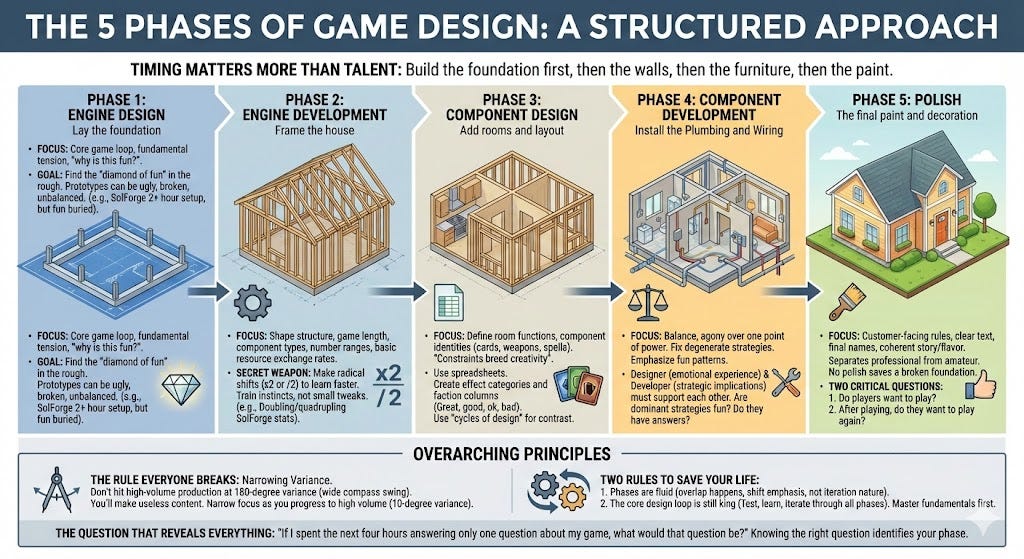
Phase 1: Engine Design — Lay the foundation
This is where you answer the big, scary questions:
What’s the core game loop?
What’s the fundamental tension?
Why is this fun?
Everything else can be ugly, broken, unbalanced. You just need to know if there’s a diamond of fun in this rough prototype. When we prototyped SolForge on paper, a single game took over two hours to set up and play. It was a mess, yet we could see the fun buried underneath.
Phase 2: Engine Development - Frame the house
Now you’re shaping the structure. Define your game length. Figure out what types of components will exist in your game and how they will be represented. Establish a general range of numbers your game will work with. Understand your basic resource exchange rates.
Here’s your secret weapon: when in doubt, times two or divide by two. Make radical shifts rather than small incremental changes so you learn faster. You are trying to train your instincts and understand the fundamentals, not get things exactly right. SolForge creatures were originally on a tiny scale. When we doubled the attack/defense ranges (and quadrupled player health), suddenly creatures felt distinct from each other. Big moves teach you faster than small tweaks.
Phase 3: Component Design - Add rooms and layout
This is where the house gets its floor plan. You’re deciding what each room does and how the space flows—from cards and weapons to characters and spells, each component gets a clear identity and purpose.
The key insight? Constraints breed creativity. Structure is critical at this stage. You need categories with clear identities. Component design is where spreadsheets are your best friend. For simple games with a few components, this phase can move quickly, but if you want to build a massive project like a trading card game, you will need to do a lot of work here.
Make a row for each type of effect in your game and a column for each of your factions / component types. For each effect, identify whether a faction is Great, good, ok, or bad at that effect. In SolForge Fusion, the Tempys faction is good at aggressive creatures, direct damage, and spell bonuses. It is bad at defensive effects and protecting its creatures. You can do the same thing with the thematics of the factions. Use cycles of design to make your work easier. A cycle is where you make a similar type of card in each faction, holding most things constant but changing only one or two things. These changes highlight the contrast between factions and help players understand the differences. Ascension did this with our intitiate cycle in our very first set, showing off both the mechanical differences and the style differences for each.


Phase 4: Component Development - Install the Plumbing and Wiring
Now—only now—do you spend hours agonizing over one point of power. This is where balance matters. Where degenerate strategies get answers. Where fun patterns get emphasized. Component development is where we shift from the big picture to the small details.
Before I was a game designer, I was a world champion professional player. Knowing how to break a game and find imbalances is valuable at this stage. The role of balancing a game is typically referred to as game development, which is a critical part of the game design process. But there’s a critical distinction between a great developer and a great designer. A great designer understands emotional experience. A great developer understands strategic implications, helping balance the game so the designer’s intent comes through. Both must support each other. Great development can’t save a game the designer made boring. And a designer unwilling to adjust based on developer feedback may never see their vision realized. At this stage, ask yourself if the dominant strategies are fun strategies, and whether or not players have answers to any given strategy. If those two things are true (and the core game loop is fun) you are most likely on the right track.
Phase 5: Polish - The final paint and decoration
Customer-facing rules. Templating with a focus on detailed text and clear communication. Final names. Coherent Story and flavor. This is what separates professional games from amateur prototypes. This phase can take just as long as the previous 4 phases combined.
But notice: this comes LAST. Because no amount of polish saves a broken foundation. In this stage, there are many details to review but only two questions that really matter.
When they see it, do players want to play your game?
After playing, do they want to play again?
The Rule Everyone Breaks
Jordan Weisman told me on my podcast: “In the beginning, you’re swinging all over the compass. Then you narrow to a quadrant. Then to 45 degrees. Then to 10 degrees as you hit high-volume production.”
The most expensive mistake is hitting high-volume production while you’re still at 180 degrees of variance. You’ll make a ton of content that’s useless.
Novice designers worry about details at the beginning when those things are completely irrelevant. They’re designing cinematics before they know if the game is fun. They’re creating that move-in flyer before the house exists.
Two Rules to Save Your Life
Rule #1: Design phases are fluid. You can’t properly test an engine without some components. You’ll discover engine improvements during component work. These phases shift your emphasis, not the essential nature of iteration.
Rule #2: The core design loop is still king. Each phase just represents a different focus as you test, learn, and iterate. You’ll complete the loop many times in each phase.
Master the fundamentals before worrying about phases. But once you understand the loop, these phases keep you focused on what actually matters.
Asking the Right Question is the Key
Want to know if you’re working on the right phase? Ask yourself: “If I spent the next four hours answering only one question about my game, what would that question be?” Knowing the right question is the key to identifying the phase you are in. Identifying the phase you are in is key to answering the right questions.
Stop polishing the backs of drawers before you’ve built the dresser. Stop balancing card costs before you know which cards belong in the game. Stop perfecting your art before you know if anyone wants to play.
Build the foundation first. Then the walls. Then the furniture. Then the paint.
Your game will thank you for it.
What phase are you actually in right now?
Reply and tell me what the biggest question is on your project and I’ll tell you if you’re building furniture on an empty lot.
Great framework Gary! I see way too many posts on design forums agonizing over artwork and graphic design way too early in the process.
I started doing this recently. I want to have a Steam page out before the end of the year so I was looking at how to put it together, but I know the gameplay loop isn't there yet. It just so easy to get the gratification of making the game look pretty over the unknown amount of time it'll take to make it good.