



About Luke Peterschmidt
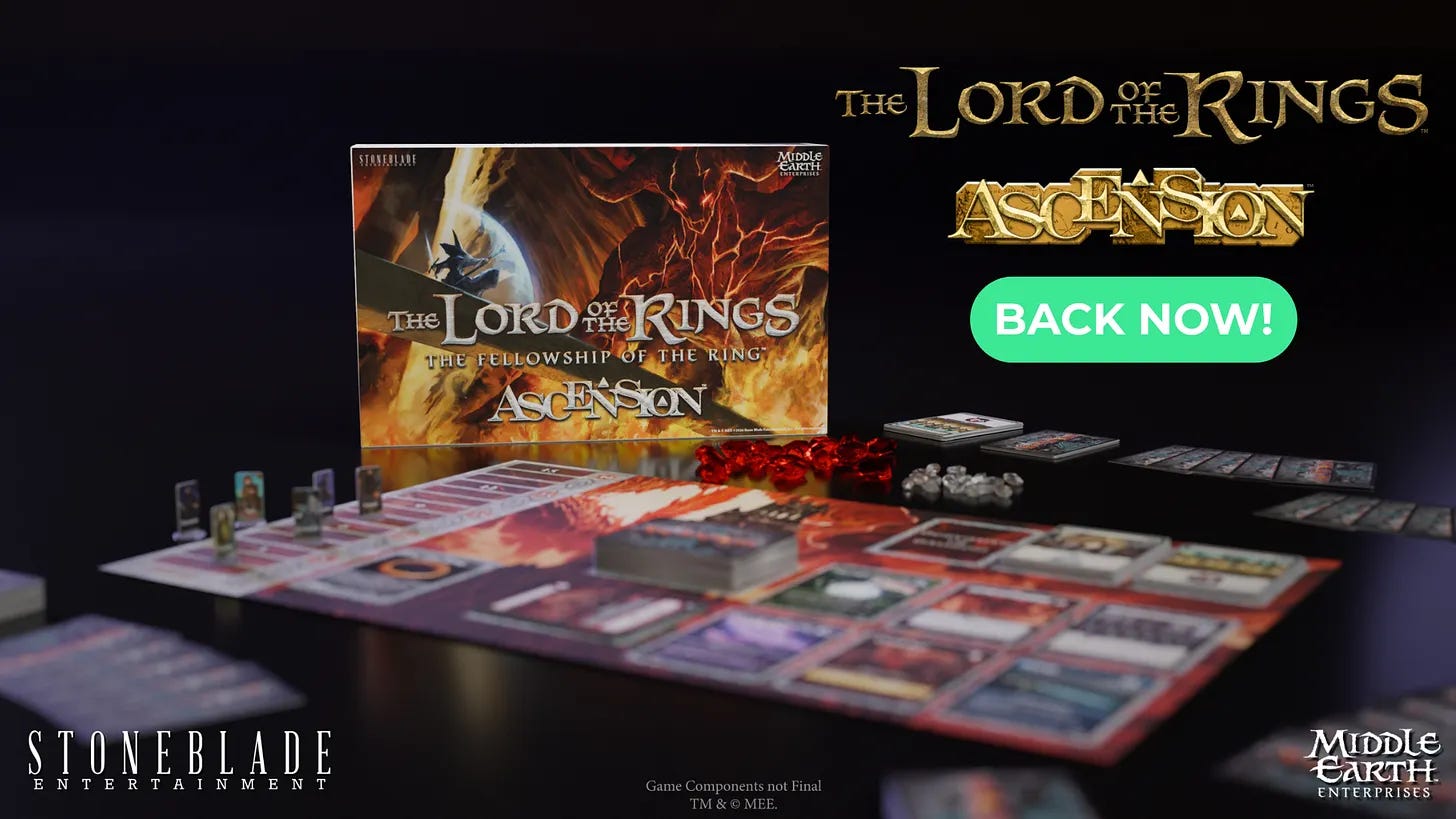
Luke Peterschmidt is a brilliant leader in the tabletop gaming industry who currently serves as the Head of Active Category Management at Asmodee. In this uniquely structured role, Luke has been managing the legendary The Lord of the Rings™ portfolio. Right now, I am incredibly lucky to be working directly with him as we partner up to launch The Lord of the Rings™: Ascension™ on Gamefound this July 14th, 2026. Luke and I have a long history of debating, discussing, and collaborating on projects across the industry, such as Bakugan. In this episode, we unpack the massive operational challenges of stewarding a world as foundational as Middle-earth, how to lead high-performing teams by getting completely out of their way, and how our creative roles must evolve as we scale up our careers. Plus, if you are catching this as it drops, Luke and I are hitting the stage together for a couple of panels at San Diego Comic-Con 2026!
Ah-ha! Justin’s Takeaways
The Pressure of Caring a Lot: Nobody wants to be the designer who goes down in history as the one who botched a legendary world like The Lord of the Rings™. Every single designer who touches an intellectual property of this magnitude feels that exact same weight. Creating inside a universe you personally worship is an unbelievable mix of intense excitement and raw terror, and it leads to a lot of sleepless nights trying to make something great. At the same time, that fear is a feature, not a bug. You want to hunt for the specific creative projects that scare you just enough to force you out of your comfort zone and push you to build a masterpiece.
Strategy is Saying No to Easy Money: True corporate or creative strategy has absolutely nothing to do with hitting a random quarterly budget number; it’s about having the discipline to turn down fast cash if it derails your ultimate vision. You have to define a strategic roadmap so crystal-clear that anyone on your team can look you in the eye, throw your own words back in your face, and tell you “no” and you have to completely agree with them. If a quick, short-term win pulls your focus away from your long-term destination, you have to let it go.
Look for Strengths, Not Weaknesses: We waste way too much mental energy trying to patch up our minor flaws instead of ruthlessly exploiting our core superpowers. In game design, a product with a few visible imperfections but a mind-blowing, uniquely memorable hook is infinitely better than a perfectly polished, completely smooth pearl that has absolutely nothing special to say. The exact same rule applies to your life. Stop agonizing over your baseline weaknesses, and instead just build a killer team or find the right tools to handle them, and pour 100% of your focus into what makes you exceptional.
Show Notes
“Maps are really important to The Lord of the Rings. When you have a fantasy world, you draw a map and you define what’s on that map, and then with time, you define further and further down. With a science fiction property, you design a universe, and then when you wanna make new stuff, you just add a new planet further away And so you’re not forced to make a cohesive world that makes sense.” (00:06:54)
Luke points out an incredible structural distinction here between worldbuilding in fantasy versus science fiction. In sci-fi, if you need a new asset, obstacle, or story beat, you can just make up a brand-new planet out in the ether. Yet, good fantasy forces you to look at a locked map and work tightly within those fixed boundaries. It’s the exact same trap designers fall into when they think infinite rules give them freedom, the truth is that true cohesive elegance only happens when you force yourself to work inside strict constraints.
“Core values like being publisher agnostic were set in stone because rationally, no one should trust Asmodee not to just keep the best stuff for themselves, right?” (00:09:00)
I love this behind-the-scenes look at how Luke set up his entire management framework at Asmodee. When you sit at the top of a massive corporate entity, people are naturally going to assume you’re going to act purely in your own short-term interest. By explicitly baking “publisher agnosticism” directly into the operation’s foundation, Luke proved through structural actions that he was taking a long-tail macro view to scale the health of the entire brand over a decade, rather than just scrambling for a quick licensing check.
“My code is for the super fans: they’re swan feather people […] they know the feather on Tom Bombadil’s hat is a swan […] when the swan feather person speaks they’re usually right.” (00:15:15)
This is a masterclass lesson on how to treat an obsessive fandom. When you adapt a world that people have spent their entire lives studying, you have to satisfy both the casual audience and the “swan feather people” who know every granular line of the lore. If your design ignores those hyper-specific details, your core community will see right through it. Pay close attention to the micro-details that your most passionate players care about—when they call you out, listen, be humble, and get it right.
“There’s nothing better to me than leaving a team or a client when I was a consultant, and then have them just crush it going forward.” (00:48:28)
We close out with a beautiful look at what true leadership actually means as your career scales up. When you are running a business or a division, you have to let go of the narcissistic need to have your personal finger on every single trophy or scoring play. Your ultimate value as a leader or an executive isn’t the work you execute directly; it’s the ripple effects of the teams you build, empower, and leave behind to crush the goals without you.
Previous Episode:

You can find Think Like a Game Designer on these platforms:


